Thursday, 13 October 2016
Two tribes go to war: making sense of the battle for Labour
Thursday, 13 February 2014
In-work poverty is the greatest moral outrage of our generation - it deserves to be treated like it
--
The moral outrage of in-work poverty
Sunday, 7 July 2013
Croatia and the EU: more questions than answers
-
Tuesday, 26 March 2013
“Politics is the only aspect of the 21st century world which globalisation [has] weakened but not transformed. It remains the only effective mechanism for social redistribution…It has its problems and abuses, but it remains the last bastion against the free market. And it needs politics – politics by collective action to move it.”
Sunday, 2 September 2012
Caro shows us the human side of politics
--
Review: The Lyndon Johnson Years: Volume 4, The Passage of Power by Robert A. Caro
Friday, 5 August 2011
A review of 'Chavs: the demonization of the working class' by Owen Jones
---
At the bottom of Leeds city centre, opposite the coach station, is St Peter’s Building. For most of the twentieth century it was home to a factory at the heart of the cities' thriving textile industry. Today it's the sort of two-a-penny bar and nightclub with granite surfaces, awkward stools and food served on wooden platters that you see on every British high street. Just the buildings tatty exterior and piping - purposefully left in place as sort of retro-industrial chic – serve to remind you of its past glories. Like most of the British economy over the last thirty years, St Peter's, or 'The Wardrobe' as it's now called, has gone from industry to service sector.
But could you call the people that work in The Wardrobe today – wait the tables, man the back office, mop the floors – working class, just as you could those that toiled in the same building a generation before? The obvious answer under any standard definition is yes: they have nothing to sell but their labour in order to survive. Yet despite
It's this crisis, of what it means to be working class in 2011, that is ultimately at the heart of Jones' debut book. He essentially argues that Britain's political and media class have conspired to misrepresent and “obscure the reality of the working class majority” through a prolonged and surreptitious class war, of which the 'Chav' caricature is the ultimate expression.
Jones opens by taking aim at the snobbery and hypocrisy that has linked public discussion of topics ranging from Shannon Matthews, Vicky Pollard and the recipients of welfare benefits. All have been used to misrepresent, or redefine, working class identity in popular imagination to mean feckless or just poor, he argues. Along the way, Jones myth-busts in a devastatingly simple way – only one in fifty single mothers, for instance, is actually under 18, while just 3.4% of families in long-term receipt of benefits have four children or more.
Jones is convincing here, but were this to constitute the whole of Chavs it would be an earnest but unfulfilling affair, the only fruit of which would probably be to rule the particular word 'out of bounds' without any deeper discussion of why.
Thankfully Jones drills down in to the subject, and it's the second half of Chavs which takes it from being a good book to a brilliant one. Jones shifts focus from the 'broad brushing' of the working class to the airbrushing – the idea that they no longer really exist. This goes to the root of a narrative that has stitched together conventional political wisdom in British politics for nearly thirty years. This, briefly summarised, goes as follows: Thatcher-era reforms liberated the working class to be aspirational; many became upwardly mobile and joined the middle classes, with just a new underclass 'left behind' – a tiny workshy rump too feckless or 'excluded' (depending on your preference for Tory or New Labour vogue) to pull themselves up or aspire. In sum, we're 'all middle class now'.
While the chav caricature feeds the confusion over what it means to be working class in 2011, to my mind the argument that both have their roots in the dominance of this narrative is the most convincing. Who would want to identify as working class when it is synonymous with failure? Why have anything but contempt for those who have not 'bettered' themselves despite all the opportunities and others supposedly doing likewise? Add in the trappings of traditional middle class lifestyles (e.g consumer goods, foreign holidays, easy credit) becoming cheaper and you can see how some convinced themselves they were on the way up as the world changed around them.
Yet the idea that 'we're all middle class now' is, objectively, complete bullshit, and Jones is at his most fluent when he is pointing out why, arguing that Britain is actually “a nation of secretaries, shop assistants and admin workers” whose true lives receive no true political or media representation, falling as it does between both the 'Chav rump' and 'new middle class' myths.
And despite a slither of new entrants into the AB social classes from below since the 80s, and popular rhetoric on aspiration, the
But what has changed is the nature of those jobs. There may be one million people working in call centres, as many as manned the pits at the peak of mining in the 1940s (one of the books most eye-popping statistics), but as Jones documents in compelling and often moving detail, the working environment they face is a world away from the one it proceeded. Modern day working class workplaces are not the centre of the community in the same way, the work more transient and insecure, often woefully paid, the workforce even less homogeneous - with the generational, gender and nationality make up entirely different. Throw in the rise of identity politics and what Jones calls “rugged individualism”, as well as the neoliberal assault on trade unionism, and the capacity for fostering a new collective, shared identity for Britain's modern day working class is massively diminished.
To be fair to Jones (a proud trade unionist), he is frank about the realities he describes, confessing the impossibility of turning the clock back on the makeup of Britain's working class. But you can't help but feel that while class should never again be allowed to disappear from our lexicon, the term 'working class' is just too loaded - with clothcap imagery from the 70s/80s, the old economy, a largely white, male and non-graduate workforce - to be resuscitated as a call to mobilisation.
But what could fill its place? Some have suggested “hard-working classes” might do the trick, or “working people” - but even when they don't sound overly focused grouped (which they do), there is still a risk definitions will become so vague as to leave us right back where we started: a wideboy banker telling Jones that “Why aren't I working class? I work, don't I?” One opening is to focus on the bottom 50% of earners currently seeing the benefits of growth trickling through to their annual pay packet decline in real terms while the top 10% increases, or even 'the squeezed middle' (as i've gone on about before). That would at least put wages back on the table as something to coalesce around. Yet still it nags that there is more to identity than crude materialism – in some senses 'what is working class today?' is just a rephrasing of 'what is English?'. And that is a whole other 294 pages.
The sheer nature of the way Britain's economy has changed makes answering these questions a tall order, and, accordingly, at times Jones seems a bit conflicted over whether he just wants proper representation of the working class as they exist today, and whether he wants to re-shape the very nature of it through industrial policy, for instance. Nevertheless, on the whole Jones' thoughtful policy prescriptions are a good place to start, if not end, the debate.
New Labour also presents its own problems. While being no great fan myself, at times it feels like Jones is a little over-personal in his critique of 'the project'. New Labourites are mostly portrayed as mendacious, scornful and generally neglectful of the people their party was formed to represent. While there's no doubt that New Labour cemented the 'we're all middle class now' myth at the heart of the chav caricature, in their case this had its first principles in an electoral judgement: a psephological argument later broadened out to a sociological one in search of self-justification. A small group of marginal voters won you elections, it was decided, and you had to focus your message on them - these small handful of marginal voters often tended to be that over-exaggerated portion of the 'upwardly mobile' working class, mostly in marginal southern constituencies like Hove, where I grew up (in fact my Dad was, and still is, one of those swing voters).
While that rested on a fallacy Jones exposes - that your 'core' vote will always turn out, hence Labour's haemorrhaging of DE voters – it remains the case that Labour still needs those southern marginals to win, it cannot do it on DE vote alone and the nature of the C1 vote there is different to much of the rest of the country, even if they are now suffering the squeeze along with most others. In lieu of electoral reform (which Jones opposes), this does seem to necessitate some positioning away from the democratic socialist purity Jones favours. Indeed at times Chavs, like a lot on the left, does wilfully ignore some of the bigger picture, such as globalisation, which long before Thatcher started squeezing wages and bankrupting industry – St Peter's factory in
But this would to be overly harsh. Jones is that unique thing, a sensible and talented left-wing radical, and Chavs is an excellent book, essential to understanding contemporary British history. While it could possibly lose some of its more baggy, pop sociology sections (an analysis of the Kaiser Chiefs' I Predict a Riot! seemed a bit far), those serve as an accessible hook for non-political nerds, allowing Jones to kickstart a vital debate outside the usual Guardian or New Left Review Circles.
It also benefits from great timing. The bottom has fallen out of Labour's electoral coalition, and the old models of growth and prosperity have broken. Ultimately, political and media elites are going to have to wake up to what Britain is really like in 2011, and rapidly update their ways of thinking. They should start by reading Chavs.
Chavs is published by Verso (£14.99). You can buy it here.
*This stat is taken frompage 33.Its original source is here.
Sunday, 2 January 2011
Why ending control orders might not be such a 'fucking car crash' for the coalition afterall
Wednesday, 1 December 2010
Fear itself: Insecurity, not ideology, is the key to understanding the Lib Dems' predicament
The tool of analysis which most of these sages have settled for their chin-stroking is that of the 'Orange Bookers' v the 'Social Democrats'. They inform us that the Lib Dems are led by economic liberals 'at odds' with the social democratic 'grass roots' or 'old guard'. This enables them to explain the history of the coalition as a product of this divide: Clegg was always 'instinctively closer' to Cameron than Brown; the two are "bound by their shared hostility to the state" (Steve Richards); "Just as much as Blair and Cameron, Clegg aims to replace British social democracy with a version of Thatcher’s market-based settlement" (Jon Gray). Even Andrew Adonis recently echoed such a view.
But this is misguided. There are differences in outlook, of course, but the party doesn't factionalise along these ideological lines. The Lib Dems who have rebelled most so far are hardly left-wing ideologues and it's simply not true that the leading lights of the party share a centre-right ideology. It's more complex than that. Chris Huhne, for instance, wrote Reinventing the State, the book frequently touted as the ying to the Orange Book's yang, while Cable comes from a Labour background and he and Clegg devised for the party a whole host of policies (on tax, inequality, banks etc.) which can scarcely be called Blairite.
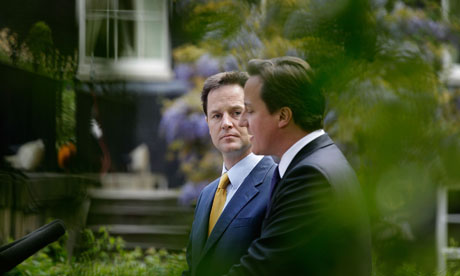
More to the point, the 'Orange book' analysis obscures the main driver of Lib Dem behaviour since 6th May: fear. Fear of another election, fear that the coalition will fall apart, fear of electoral decimation at the hands of the Tories.
Most detailed histories written of the Coalition so far suggest it itself was conceived in fear. During negotiations and after, Cameron held up (explicitly and implicitly) the threat of a snap second election in autumn should the Tories be forced into minority government. There's a good chance this would have allowed them to blame Lib Dems for the preceding 'muddle' and turbulence, campaign for a majority and wipe many of the already fragile marginals the Lib Dems hold off the map. It seems the fear of this, with a deal with Labour not viable, is primarily what drove Clegg to lock himself and his party so firmly into a five year coalition, rather than any 'confidence and supply' arrangement.
The trouble the party is now facing, is that this logic is now perpetuating itself over and over again and it is spiralling the Lib Dems into electoral oblivion. Fear that the coalition will collapse and of the resultant election seems to be playing a significant part in justifying faithful parroting of the Tory line, word for word, on almost every issue.
This has lead to the Lib Dems being almost indistinguishable from the Tories, and seen the party's poll ratings plummet. Yet, ironically, the more the polls sink the more the logic justifies itself, as by implication the worse the election performance would be. This is a large part of the architecture of the Lib Dems own 'There is No Alternative' narrative on the coalition.
It's a dangerous gamble, based on the premise that if the economy recovers, by 2014-2015 the Lib Dems will be rewarded in the polls. But polling since May has already shown cuts and fees have punished the Lib Dems disproportionately to the Tories. So if Tory/Lib Dem poll ratings and electoral performance are not fixed to each other, then neither should the Lib Dem and Tory line.
So where now?
While not being an expert myself, I'd say it's been fairly obvious from the start that the main way the Lib Dems can succeed in coalition is by being seen to sand down the edges of Tory extremism and carrying, as far as possible, the 'equidistance' ethos of opposition into government. But their current approach of hugging the Tory line close from the beggining militates against this, limiting Lib Dem influence and hamstringing the party's ability to promote any genuine concessions.
Take higher education reform as a case in point. The Browne review reccomended lifting the cap on fees. But that day, Cables support for the review was full throated. It was Cameron, then Willetts, that signalled the row-back and eventually the retention of a cap. This should have been the other way around! The Lib Dems initial echoing of the Tory line left them no room to sieze on improvement to Browne. If they had taken a step back, staked their opening position a little more carefully, briefed their opposition a little more openly, put their name to row-backs, they could possibly have limited the damage they are suffering on this issue now. At the very least, this approach provides a good template for other, less totemic, policy issues going forward.
Instead, their actions suggest that behind closed doors the Lib Dem leadership is being bullied by the Tories and their spindoctors. Its probably also a case of Westminster politicians operating according to Westminster orthodoxy: difference equals 'splits', splits are bad. But the Lib Dem leadership needs to think outside this political box. Just hanging is not a strategy that will ensure the party's recovery.
What is needed is at least a kind of 'ochestrated disagreement'. Clegg and co need to argue for room to be seen to disagree from the beggining on certain issues, to be seen to force concessions and claim them as their own – school sport presents the latest opportunity. They need the spirit of their coalition negotiations within government, to openly define themselves as much against the Tory right as Labour. This would give them a platform to build on for the 2015 election, wheras on present course it's difficult to imagine how they could forge one.
The leadership should argue with Coulson and Cameron the need for flexibility in this respect – there is no reason if they are aware of this strategy that it will break the coalition. Moreover, the Tories own poll ratings are worsening and there's no guarantee they themselves would fancy their chances in a snap election. The Lib Dems may have more room for manoeuvre than they think in this Coalition- but if they don't start to properly use it, they'll continue to lose it.
Friday, 25 June 2010
New Labour meets its maker: cuts, TINA and the future of centre-left politics in Britain
There was a strange and queasy moment during last months Queen Speech debate when, returning Harriet Harman's questions from the Labour side of the House, David Cameron leant over the despatch box and advised: “Let me give a little warning: I can tell you, having sat on the Opposition Benches for the past nine years, that opportunism does not work.”
Coming from a politician as intellectually vacuous as Cameron, the hypocrisy was enough to make your eyes bleed. The queasiness, though, came from the ring of truth to the statement and its broader implications. Labour have not formed a coherent intellectual argument against the Conservatives, the new Coalition government or the significant cuts in public expenditure imminent. Neither have many prominent progressive figures.
Conservative language on cuts and the economy is now largely hegemonic in public life. It's widely seen as a matter of absolute necessity that cuts are deep, immediate and far reaching. Phantoms of Greece are summoned and we're told (wrongly) that our situation is analogues, and that all hell will break lose unless cuts are made. A state of exception/emergency style logic has been set up through which every decision to cut is explained and incorporated, no matter how small the saving or socially damaging the impact; case in point here is the cancelling of a loan to Sheffield Forgemasters, essentially described as regrettable but 'unavoidable'. In sum, the politics is being stripped out of highly political decisions.
This is the way Conservatives do business. The whole Thatcher era was built on the idea that a small state and free market was an unavoidable necessity, that There Is No Alternative (TINA) to neo-liberal prescriptions of economic growth, the state ('waste') and the market ('efficiency'). Opposing it was like opposing ageing. Now, as then, the refrain in face of opposition is: “ah yes, but what would you do?”. The worrying sign is that much of the public accept the TINA argument, as surveys and the Conservatives unblemished poll ratings attest (here and here).
Many in the Labour ranks seem to think this support simply owes to the Coalition's honeymoon period; that once the pain kicks in voters will come home. But the problems are more systemic and they involve New Labour's ability to counter the TINA narrative.
That problem is that New Labour, owing to a post-mortem of its defeats in the 70s and 80s, is itself predicated on a peace pact with Thatcherite/neo-liberal political economy and the TINA argument, from which Conservative arguments on cuts emerge. This is not to say it continued Thatcherism, but it accepted it as a framework for economic growth, believing a trade off between investment in public services and free market economics to be a false one; basically their departure from Conservatives concerned what to spend the proceeds of growth on, rather than the model for generating that growth.
What followed was, rightly or wrongly, an adoption of much Conservative language and idioms; idolising 'wealth creators', a view that a sustainable economy could centre on financial services, unfettered movement of labor, 'you can't pick winners', a focus on 'choice' in public services, that government should 'get out of the way' for entrepreneurs, and so on. Many of the policies which flowed from this world view (de-regulation in particular) lead to the very financial crisis which now puts a question mark under the previously untouchable neo-liberal model (such crisis were not supposed to happen in dynamic, free market economies, afterall).
But by broadly adopting that model's language and economic logic, Labour has helped entrench it among the public and tied its own hands in opposition to cuts, not least by posturing to the markets before the election that cuts would be deeper than under Thatcher. That's why it now seems opportunistic and doomed in its tentative forays into Keynsian language (talking about jobs, government stimulus, pushing back against the deficit hawks), when for years it parroted neo-liberal mantras and defined any alternative as an untenable return to the past. At the top level, at least, it has lost a language of social value, of state involvement in the economy, that is now so unfamiliar as to seem cheap and unrealistic.
That is why many mainstream Labour party activists needs to take the opportunity of a leadership election to assess how much they believe in the idioms I listed above, a wholesale critique (rather than temporary), which need not lead to outright rejection by the way, of the fundamentals upon which New Labour was based. You can see a partial attempt at this in its intellectual acrobatics over the movement of labor and immigration, where it seems to be trying to face in both directions at once. It is not currently a party with coherent ideas of political economy or language; until it is, its policies will continue to seem like a series of positions and postures.
In undertaking this review, it would carry with it the future of progressive politics in Britain (at least while the Lib Dems are locked into coalition) and Western Europe, which desperately needs an over-arching, alternative economic vision for spasms of unrest or discontent to coalesce around.
This does not have to indulge a culture of betrayal that says all New Labour has done is wrong, but to realise that the New Labour project was a product of its time, and times have changed. Significant doubts over the neo-liberal/Thatcherite system of economic growth have arisen for the first time in a generation. Opposing it need no longer be seen as electoral suicide. The public could, over time, be swayed by a credible alternative narrative, especially if lefties are savvy and play on events cleverly (the crash as private sector failure, bankers greed, forthcoming pain from public expenditure cuts etc.).
Such a narrative would not be afraid to talk about raising income tax again, about a higher minimum wage, or the inequities private education still entrenches, for instance. More importantly, it would not be afraid to talk about government investment and stimulus to create a re-balanced economy, less dominated by financial services in London, so kids growing up in Stoke or Leeds have more options than either going to University or getting a job in a call centre or supermarket (Paul Mason has done a great piece on this). It would not row back the moment it was accused of being 'anti-city' or 'anti-aspiration'. In sum, it would not be afraid to talk about the state again, in the face of a Conservative ideology which sees the state as the problem.
Only if New Labour, and the left, can generate an alternative political economy in this way, can their opposition to Tory cuts seem anything but opportunistic, and the idea that There Is No Alternative be chipped away at and finally dislodged. One of Blair's many talents was an ability to spot a moment and build an agenda around it. His post 9/11 words, which defined change in the international political system in the last decade, could and should easily apply to the economic system in this. "The kaleidoscope has been shaken, the pieces are in flux", he said. "Soon they will settle again. Before they do, let us reorder this world around us.". It is into this spirit which progressives, of every stripe, should tap in to in 2010.
--
Twitter: @SteveAkehurst
Bit more reading, for anyone interested:
Ross McKibbin
Simon Johnson
Tony Judt
Guardian editorial
Dean Baker
Jon Cruddas
Laurie Penny
Stuart White
David Aaronovitch and John HarrisPaul Krugman